
‘Networking’, ‘connecting with people’ and ‘meeting my co-experts of the Community of Practice in real life’. These were some of the reasons people gave for attending the fourth Annual Event of the Global Health Hub the Netherlands (GHH-NL). The morning programme took place at the Ministry of Health, Welfare and Sport, followed by the afternoon programme at De Nieuwe Kerk in The Hague. The GHH-NL brings together knowledge institutions, civil society organisations, the private sector, the government, and other partners. As part of the Dutch Global Health Strategy 2023–2030, the network supports knowledge exchange and cooperation across its Communities of Practice.
The fourth Annual Event of the Global Health Hub explored what resilience in health means in practice. Across the programme, speakers and participants linked resilient health systems with trusted public institutions, reliable financing, community involvement, international cooperation and the ability to work across organisational boundaries.
Morning programme: simulation exercise and thematic discussions at the Ministry of Health, Welfare and Sport
The morning programme was open to GHH-NL partners involved in one or more of its three Communities of Practice (CoPs), which align with the priorities of the Dutch Global Health Strategy. Mark van Passel, Coordinator of the Dutch Global Health Strategy at the Ministry of Health, Welfare and Sport, chaired the programme. It opened with welcoming remarks from Andrea Connell, Deputy Director International Affairs and Manager Global Affairs at the Ministry of Health, Welfare and Sport, and Debby Toren, Deputy Head of the Global Health and SRHR Division of the Social Development Department at the Ministry of Foreign Affairs.
Participants then took part in ‘Critical Choices: Beyond the Pathogen’, a simulation exercise co-developed by Global Health Hub Germany and the World Health Organization (WHO) Unit of Mental Health, Brain Health and Substance Use. The exercise showed how outbreaks can affect not only physical health but also mental health, social cohesion and trust in the response.
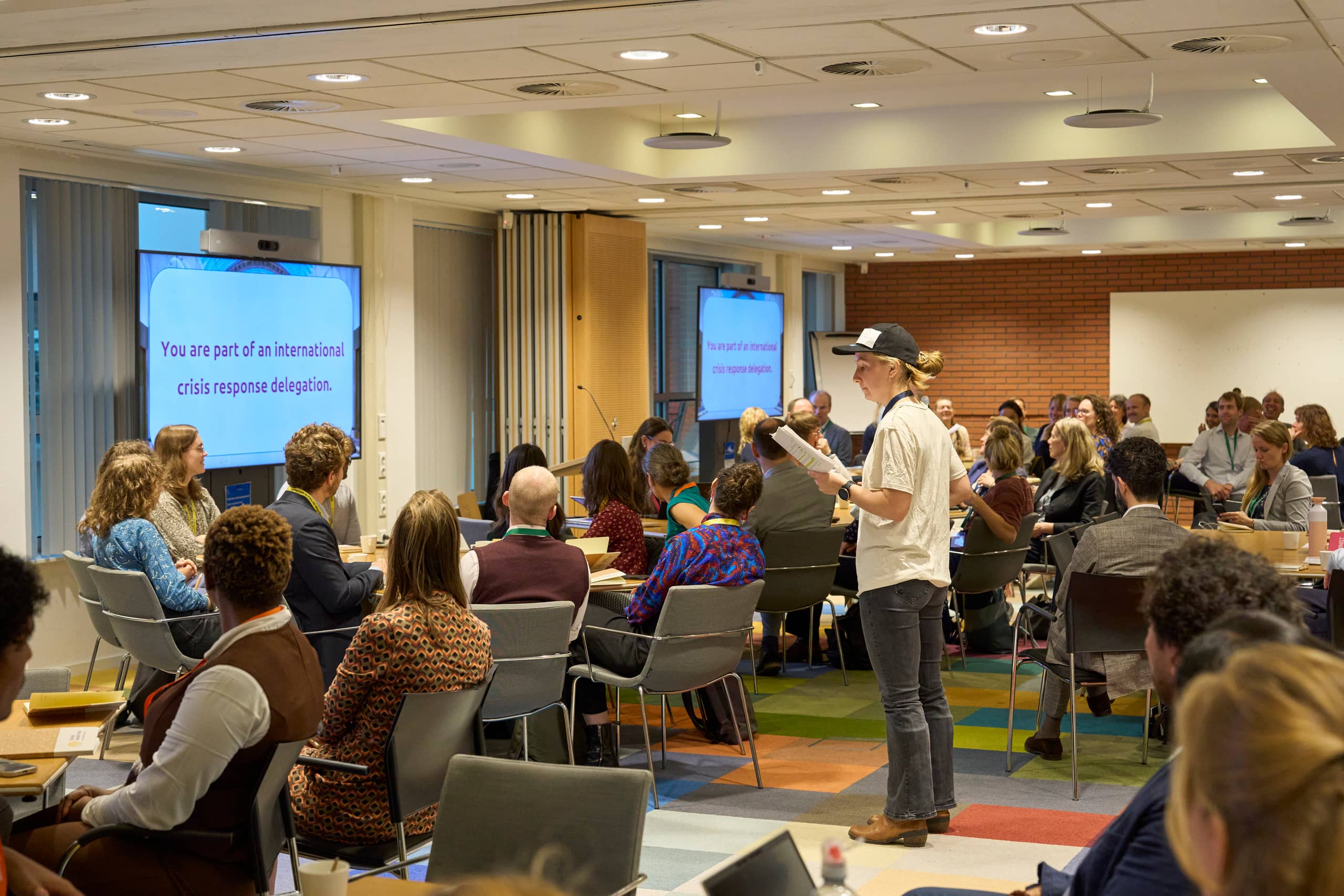
During the second part of the morning, participants split into the three CoPs for an interactive session on the social dimensions of the Dutch Global Health Strategy’s themes. Members of the GHH-NL Youth Advisory Body (YAB) joined as table hosts, bringing the perspective of the next generation directly into the discussions. The resulting posters were displayed during lunch at the Information Exchange Market, allowing participants to see what the other CoPs had discussed.
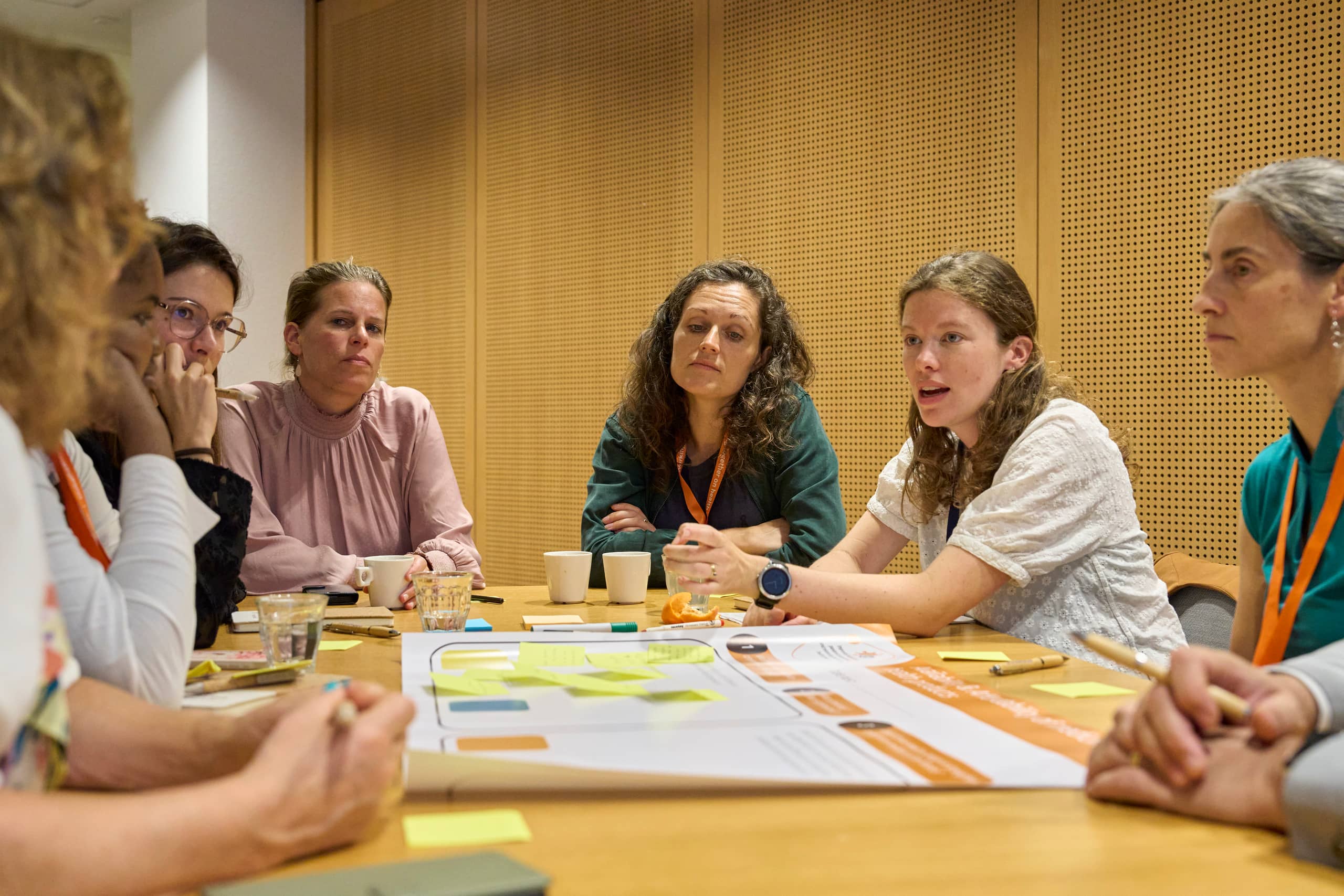
During lunch, partners could visit the Information Exchange Market, where they could learn more about the work of others and build connections. This informal format created space to exchange experiences and strengthen the network before the afternoon plenary session began.
Setting the scene: learning from history
Moderator Kim Coppes opened the afternoon programme by asking participants how health threats had changed across generations. The discussion touched on the HIV/AIDS epidemic, vaccine hesitancy, climate change, mental health and the prospect of another pandemic. One example was the changing public debate on vaccination: ‘Vaccinations: normal in the past. But contested today. Why? Because of misinformation!’
Minister Sjoerdsma of Foreign Trade and Development Cooperation
Sjoerd Sjoerdsma, Minister of Foreign Trade and Development Cooperation, presented international cooperation as both an expression of solidarity and a matter of Dutch interest. Quoting Dolly Parton before adding his own appeal, he said: ‘If you don’t like the road you’re walking, start paving another one’. And I’d like to add: let’s do it together’. He emphasised that conflict, poverty, disease and climate change cross borders and continue to affect vulnerable groups disproportionately.
He cited mis- and desinformation, declining confidence in science, and pressure on human rights from a well-organised anti-rights movement as threats to resilient health systems, and reasons to strengthen cooperation among civil society organisations, researchers and democratic institutions.
‘So let’s work together. Stick together. And stand up for
our hard-earned achievements. Speak up. Counter the
anti-rights movement. Counter its narratives. Strategize
and operate more effectively to win. In the Global Health Hub,
in hospitals, in universities, everywhere.’
The Minister furthers emphasized international and intersectoral collaboration as a means to protect the remarkable progress made in global health so far: global child mortality, for example, has fallen by more than half over the past 30 years. Partnerships such as Gavi and the Global Fund have played an important role in improving health worldwide. Sjoerdsma: ‘It took combined efforts from people in science, healthcare, development organisations, civil society, governments and many more, to achieve it. But this progress wouldn’t have been possible if people and patients didn’t trust the science, the medicine, the treatments, and the medical staff.’
Responding to a question from Anish Arun of the GHH-NL Youth Advisory Body, Sjoerdsma argued that declining international financing for health makes careful spending, national ownership and equitable partnerships increasingly important.
Marjolijn Sonnema on linking Dutch public health and international cooperation
Marjolijn Sonnema, Director-General for Public Health at the Ministry of Health, Welfare and Sport, described an environment in which several health threats can emerge simultaneously and reinforce one another.
‘What we choose to build today will help determine
how resilient we are when the next crisis arrives.
We cannot predict every crisis, but we can prepare to face
them together. For the generations living today, and for
those yet to come.’
Sonnema used the concept of a polycrisis, in which multiple crises occur at the same time and reinforce one another, to connect infectious disease and misinformation. Referring to the RIVM Global Risk Assessment of Public Health in the Netherlands, she cited the unprecedented spread of Ebola and pointed to misinformation as a factor that can intensify public-health risks. Her central point was that health threats increasingly coincide and interact: ‘Polycrises make working together more important than ever. Interconnected health emergencies require interconnected solutions.’ She described GHH-NL as a vehicle for that cooperation: ‘It brings together different sectors and perspectives around the shared priorities of the Dutch Global Health Strategy.’
Asked how organisations could break down silos, Sonnema drew on lessons from the responses to COVID-19 and hantavirus. Periods of relative calm should be used for simulations, learning and adaptation, she said, so that organisations know how to work together when a new crisis emerges. She also stressed the value of learning with younger generations.
Youth participation: moving from presence to influence
The session opened with contributions from two young people who have experience in applying their expertise and perspectives for inclusive policy making. Lune de Rijck, Youth Ambassador for sexual and reproductive health and rights, gender equality and bodily autonomy, argued that young people are already working on health issues and should have a say in the decisions that affect them. In addition, Isa van der Schaaf, Youth Delegate, linked meaningful participation to co-creation, partnerships and feedback mechanisms that show young people how their input is used.
The Global Health Hub launched its Youth Advisory Body (YAB) on 17 April 2026. It consists of nine students and young professionals under the age of 30, with three members participating in each Community of Practice. Each group includes a Youth Advisor who connects the young members with the relevant CoP co-leads. IFMSA-NL played a key role in establishing the body.
‘This is the promise of youth: we can learn together.
Work together. We want to step up now! We have
ambition. And we promise: we will deliver!’
Four YAB members reflected on the body’s pilot phase. They valued the opportunity to contribute their experience to the Global Health Hub but said that the Communities of Practice could be more accessible. Their message was that participation must be built into GHH-NL’s work if young members are to contribute meaningfully rather than serve as symbolic representatives.
In discussions on the day’s theme, participants linked resilience to trust in public policy, institutions and one another. Suggested responses to mis- and disinformation included engaging people through social media, tailoring messages to different audiences and creating space for other perspectives.
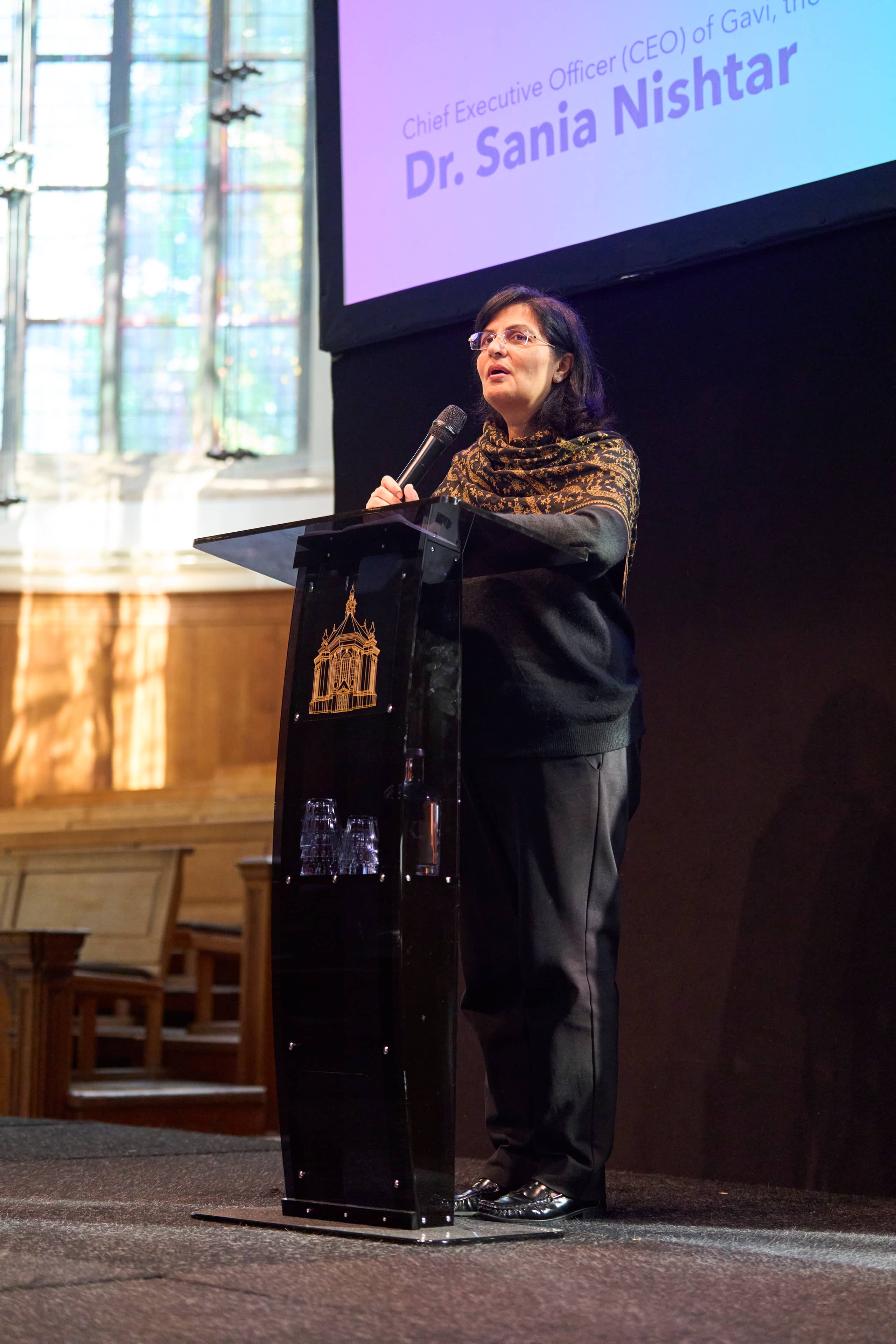
Sania Nishtar on vaccination, equity and reform
Sania Nishtar has served as CEO of Gavi, the Vaccine Alliance, since 18 March 2024. A physician from Pakistan, she has experience in health policy, government and social protection. From 2018 to 2022, she served as Special Assistant to Pakistan’s Prime Minister on Social Protection and Poverty Alleviation, with the status of a federal minister.
Gavi’s 2026–2030 strategy prioritises equitable access to vaccination, especially for children from vulnerable communities. It also emphasises stronger health systems, integrating immunisation with primary care, sustainable domestic financing, community engagement and regional vaccine production.
‘Internationally working together is becoming scarcer.
We have to prepare each other for new challenges.’
In January 2026, Nishtar called for more decision-making power to shift to national governments. Shrinking global health budgets force countries to make difficult choices about immunisation programmes. In her speech, Nishtar outlined three priorities for Gavi. The first was to operate even more efficiently. Second, she called for investments in African vaccine manufacturing. Third, she emphasised the need to respond rapidly to emerging crises: ‘One of our new instruments is The First Respond Fund’. We used it in the Ebola crisis to ensure access to vaccines for people who otherwise would not have access.’
Kiama de Wagt, a YAB member, asked: ‘Vaccines need to be transported under challenging circumstances. With knowledge of the supply change and a need for (for example) refrigerators, how do you cope with that?’ Nishtar replied: ‘Even in places where there is only access to water, and where there is no electricity, Gavi delivers. You will can find Gavi solar powered refrigerators in very remote areas, to keep the vaccines in good condition.’
Closing remarks
Andrea Connell, Deputy Director International Affairs and Manager Global Affairs at the Ministry of Health, Welfare and Sport, closed by emphasising intergenerational cooperation and the need to listen to young people as partners. Peter Derrek Hof, Ambassador for Women’s Rights and Gender Equality and Director Social Development at the Ministry of Foreign Affairs, returned to the event’s central message: stronger networks and meaningful participation depend on giving people a genuine role in decision-making.
To summarise the day
The discussions showed that resilience is a shared capacity, built through collaboration across institutions, public services, communities and generations. No country, institution, sector or individual can address global health threats alone. Building resilience for future generations therefore requires the meaningful participation of all, including young people: they need access to the work, opportunities to shape decisions and feedback on their contributions. The challenge now is to carry the day’s conversations and ideas forward by strengthening cooperation within and beyond the GHH-NL partners and Communities of Practice.